
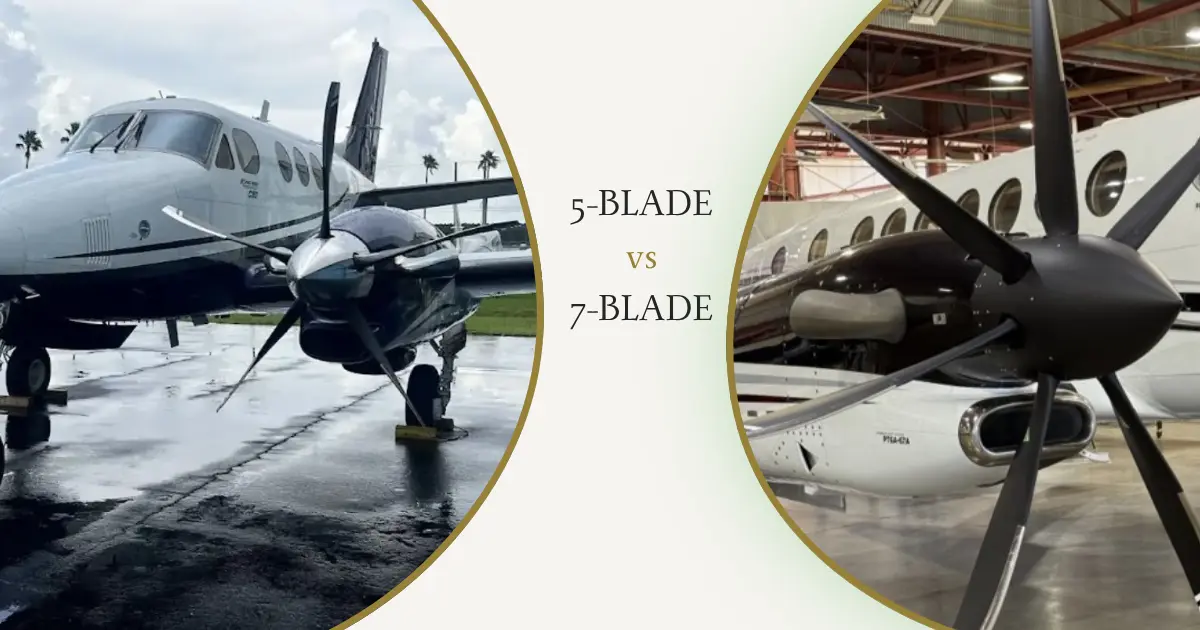
Quick answer: The 5-blade vs 7-blade Whisper Prop King Air decision comes down to two things, what your airframe is eligible for, and what you’re trying to gain. If you fly a King Air 90, 200, 250, or 260, the 5-blade BLR Whisper Prop is currently your only Whisper option, and it’s a strong one. If you fly a King Air 300, 350, or 360, you now have a real choice between the 5-blade and the newer 7-blade Whisper Prop, and the right pick usually comes down to mission profile, cabin priorities, and how much you value the last measurable step in noise reduction. This guide walks through how I think about that decision with owners.
The 5-blade vs 7-blade Whisper Prop King Air decision in one paragraph
I’ve been in aviation for more than 50 years, and I’ve watched a lot of King Air owners spend longer on the propeller decision than they need to. Here’s what most of them find once we talk it through:
- The 5-blade Whisper Prop is the workhorse. It fits most King Air models, has years of in-service track record, and delivers the big jump in cabin quiet and vibration reduction that owners tell me they notice on the first flight.
- The 7-blade Whisper Prop is newer; FAA and EASA STC approval came through in March 2025, and it’s currently available only for the King Air 300 series. It’s built on the same MT Natural Composite technology as the 5-blade, but optimized for the last measurable step in quietness.
If your airframe is eligible for both, the honest question isn’t “which is better.” It’s “what do I most want to gain?”
What the Whisper Prop is (and why it earns the name)
Both Whisper Prop systems are manufactured by MT-Propeller in Atting, Germany, and distributed worldwide by BLR Aerospace, headquartered in Everett, Washington. According to BLR, each blade is built around a resin-infused wood core (beech and spruce hardwoods) wrapped in carbon fiber composite skins, with a nickel-cobalt leading edge for erosion protection.
The wood core is the piece most owners don’t expect. BLR reports that it gives the blade a 45% higher damping coefficient than a comparable metal propeller, which is a technical way of saying the propeller absorbs vibration rather than transmitting it into the airframe. That’s why owners consistently describe the cabin as noticeably quieter and smoother. It’s not just the blade count. It’s the material.
Both props are also smaller in diameter than the OEM propellers, which brings a few underappreciated benefits: better ground clearance, less FOD kicked into the blades and engine, and a cleaner ramp signature.
Which King Air models are eligible for each prop?
This is where the decision often narrows on its own:
| King Air model | 5-Blade Whisper Prop | 7-Blade Whisper Prop |
| 90 series (C90, E90, C90GT, C90GTx) | Available | Not currently available |
| 200 / B200 / 250 / 260 | Available | Not currently available |
| 300 / 350 / 360 | Available | Available (STC approved 2025) |
If you’re outside the 300 series and want a Whisper Prop, the 5-blade is your answer. If you’re in the 300 series, keep reading.
The 5-blade vs 7-blade Whisper Prop King Air decision: five questions I walk 300-series owners through
When a King Air 300, 350, or 360 owner calls to ask which prop to choose, we usually work through these five questions together.
1. How much of your mission is passenger-facing?
If you’re routinely flying owners, executives, or clients in the back, every decibel of cabin noise matters. The 7-blade is engineered for the last measurable step in quiet, and that’s where it shines. If your King Air is primarily a tool for pilots and crew, training, freight, utility, ISR, the 5-blade already delivers the big jump, and the incremental gain matters less.
2. How much do you value the “wow” on the ramp and in the cabin?
I won’t pretend this doesn’t matter. Owners who’ve upgraded regularly describe passengers commenting on the quiet before the airplane has even broken ground. The 7-blade takes that experience even further. Some owners want that; others get everything they need from the 5-blade.
3. What’s your maintenance and support picture?
The 5-blade has more years in service, a larger installed base, and a more established parts and support network. The 7-blade is newer to certification and, at this stage, a smaller fleet. Both are supported by MT and BLR’s global service network, and both use the same underlying composite technology but if you operate in a region where support logistics matter, that’s a conversation worth having up front.
4. Are you planning to pair it with BLR Winglets?
BLR publishes performance data for the Whisper Prop + Winglet package as a combined system, and there’s a certified Flight Manual Supplement for that combination on the 90GTx and 200. If a winglet upgrade is on the roadmap, we should plan the two decisions together rather than separately sequencing matters.
5. Are you considering an engine upgrade in the same window?
If you’re weighing the Blackhawk XP67A Engine+ upgrade, note that it’s now certified with the 7-blade Whisper Prop. Sequencing these upgrades matters. I’ve seen owners spend more than they needed to by doing them in the wrong order.
When I usually recommend the 5-blade
- The airframe isn’t a 300 series (in which case the 5-blade is the choice).
- The owner wants a proven, well-supported upgrade with a long service track record.
- The mission is a mix of pilot-focused and passenger-focused flying.
- Budget is a factor and the marginal quietness gain of the 7-blade isn’t the top priority.
When I usually recommend the 7-blade
- The airframe is a King Air 300, 350, or 360.
- The mission is heavily passenger-focused and cabin experience is a top priority.
- The owner is planning a comprehensive upgrade (engine, prop, winglets) and wants the newest available technology as part of the package.
- Ramp presence and “quietest available” matter for the owner’s brand or client-facing use of the aircraft.
About On-Wing Consulting
On-Wing Consulting is based at Wiley Post Airport (KPWA) in Bethany, Oklahoma. I’m the independent sales representative for BLR Aerospace’s Whisper Prop and Winglet systems for the Beechcraft King Air series, and I work with owners and operators worldwide from Oklahoma to Europe, Australia, and Asia. My model is simple: you talk to me directly, from the first question to the last, and you don’t get handed off partway through the process.
Frequently asked questions
Can you put a 7-blade Whisper Prop on a King Air B200?
Not currently. The 7-blade BLR Whisper Prop is approved for the King Air 300 series. For the King Air 200 and B200 series, the BLR Whisper Prop option is the 5-blade system.
Owners evaluating a propeller upgrade for a B200 should therefore compare the available 5-blade Whisper Prop with applicable 4-blade alternatives rather than treating the 7-blade system as a B200 option.
Learn more about Whisper Prop options for King Air aircraft.
How does a 5-blade prop compare with a 4-blade prop for King Air B200 noise?
Blade count alone does not determine propeller noise. Propeller diameter, blade design, materials, RPM, and aircraft configuration all influence the final result.
For the King Air 200/250/260 family, BLR’s published propeller comparison lists the 5-blade Whisper Prop at 77.7 dB(A), lower than the 4-blade systems included in that comparison. The composite construction and smaller propeller diameter are designed to help reduce both noise and vibration.
Owners should evaluate noise performance together with takeoff performance, climb characteristics, weight, ground clearance, maintenance requirements, and overall mission needs.
Who manufactures the Whisper Prop?
Both the 5-blade and 7-blade Whisper Props are manufactured by MT-Propeller in Atting, Germany, and distributed worldwide by BLR Aerospace, headquartered in Everett, Washington. On-Wing Consulting is BLR’s independent sales representative for the King Air platform.
What’s the propeller actually made of?
Each blade has a structural core of resin-infused beech and spruce hardwood wrapped in carbon fiber composite skins, finished with a nickel-cobalt leading edge. According to BLR, the wood core provides a 45% higher damping coefficient than a comparable metal propeller, which is what drives the reduction in cabin noise and vibration.
How much quieter is the Whisper Prop than the OEM propeller?
BLR publishes model-by-model comparisons, and the numbers are different for a 90 than for a 350. Rather than quote a single figure that may not apply to your airframe, I’d rather look up the specific comparison for your model and share it directly. Call or email and we’ll pull it.
Can I combine the Whisper Prop with BLR Winglets?
Yes. BLR publishes performance data for the combined package, and there’s a certified Flight Manual Supplement for the 90GTx and 200. If you’re planning both upgrades, we should coordinate them together.
Ready to talk through the 5-blade vs 7-blade Whisper Prop King Air decision?
If you’re evaluating a Whisper Prop for your King Air, the best next step is a conversation, not a spreadsheet. I’ll walk you through what’s eligible for your airframe, what I’d honestly recommend, and what to plan for from quote to install. No sales hand-off. Just a direct conversation.
Dave Chapman On-Wing Consulting Inc.